

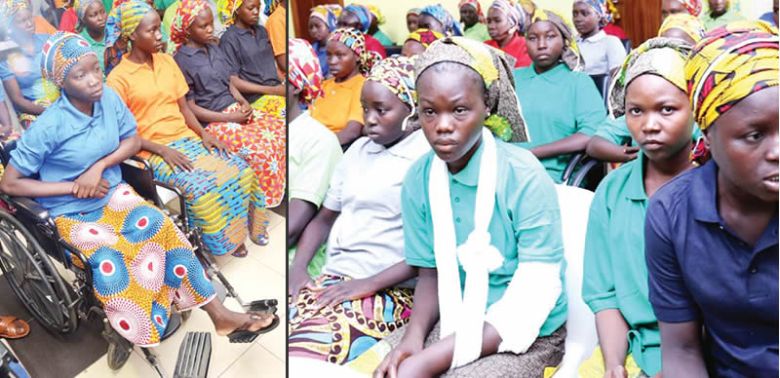
One of the negotiators involved ith the release of the 82 Chibok school girls said on Monday that some of the girls abducted by Boko Haram militants from Government Secondary School, Chibok, Borno State in April 2014, refused to be part of a group of girls freed at the weekend.
A legal practitioner and mediator, Zannah Mustapha disclosed this when he spoke with Reuters.
The 57-year-old Mustapha, who was an intermediary in the latest negotiations between the Nigerian government and Boko Haram, said some of the abducted girls refused to embrace freedom, fuelling fears that they have been radicalised by the jihadists, and might be afraid, ashamed or even too powerful to return to their old lives.
“Some girls refused to return. I have never talked to one of the girls about their reasons,”
“As a mediator, it is not part of my mandate to force them (to return home),” Mustapha said.
He said that future talks between the government and Boko Haram would extend beyond the release of the remaining Chibok girls in captivity and focus on negotiating peace in the conflict-hit North-East.
His role as a mediator dates back to 2007, when he founded the Future Prowess Primary School in Maiduguri, capital of Borno State.
The school remained open when the insurgency started in 2009 and has reportedly even enrolled the children born to Boko Haram fighters.
“We are not just talking; we are still actively working towards peace.
“Even though we have got (some of) the girls back, I don’t feel we have made much progress. After the (release of) the 21 girls, how many hundreds have been killed by suicide bombings?”
“While Boko Haram may indeed hold out in releasing all of the hostages to maintain some form of leverage, the reality is that the girls have limited value to the sect outside of public relations capital and are likely placing a strain on resources, ” Mustapha added
On why some of the girls refused to be freed, a Nigerian psychologist, Fatima Akilu, believed that the girls might have preferred to identify with their captors instead of embracing freedom due to what she called “Stockholm Syndrome”.
Akilu, head of the Neem Foundation, a non-profit group aimed at countering extremism in Nigeria, explained:
“They develop Stockholm syndrome, identify with captors and want to remain,” said Akilu, who has run deradicalisation programmes for Boko Haram militants and women abducted by them.
“Some are afraid of what to expect, the unknown. We don’t know how much influence their husbands have in coercing them not to go back.”
82 of the Chibok schoolgirls, out of the about 300 students, abducted from their hostel in 2014, were released on Saturday in exchange for detained Boko Haram terrorists after over three years in captivity.
Recall that in October last year, 21 of the kidnapped girls were released in a deal brokered by Switzerland and the International Committee of the Red Cross. Two other girls were reported to have been separately found.
It is believed that over 100 of the girls are still been held in captivity by the terrorists – if all of them are still alive. It is feared that some of them may have been brainwashed to go on suicide missions.
 cpcnews.org