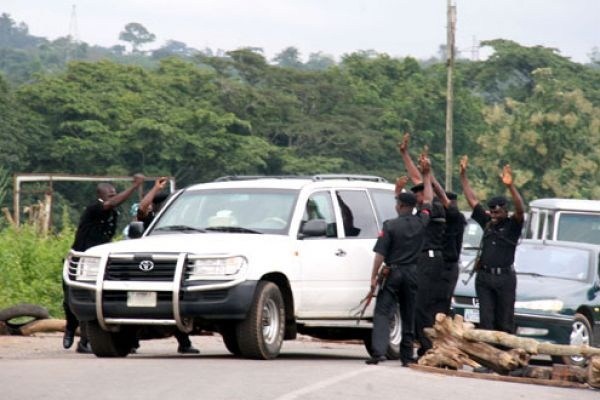

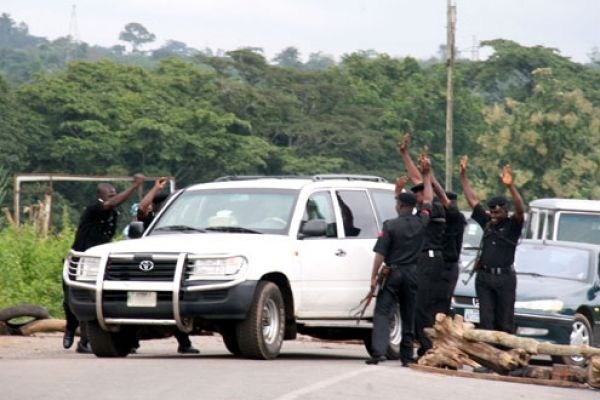
A new report on Monday accused Nigerian security and law enforcement forces of pocketing as much as N100 billion in roadside bribery and extortion in the southeastern part of the country alone over the last three years.
In a statement the International Society for Civil Liberties & the Rule of Law said findings into the report began in August 2015, and accompanied it with pictures that showed officers receiving bribes at checkpoints.
The report claimed the Nigeria Police Force pocketed N78.02 billion, the military (Army, Navy and Air Force) received N6 billion and paramilitary formations (Customs, Road Safety, NAFDAC and NDLEA) took N16 billion. These totalled N100.02 billion ($330 million).
Emeka Umeagbalasi, a senior official at Intersociety who coordinated the report, said it was released to coincide with this year’s Yuletide, during which bribery and extortion by security agencies are said to be at their peak as millions embark on holiday trips to the Southeast.
“We hope this would help those travelling home to celebrate Christmas be aware of the tactics of security agencies, and the disastrous economic impact on the region,” Mr Umeagbalasi said.
The Nigerian Army and the Federal Road Safety Corps immediately dismissed the report, telling PREMIUM TIMES their respective personnel operate with strict ethical standards and those identified for misconduct are usually promptly disciplined.
Know your levy
The report, titled: Welcome to Southeast Region: Nigeria’s Headquarters of Official Highway Robbery; was conducted in all the Southeast states and some parts of Delta State with predominantly residents of Igbo origin.
Intersociety said it found that the security agencies have designed specific levies for different categories of motorists across the Southeast, and enforcement sometimes turns deadly.
“For every shuttle or Mitsubishi L300 bus loaded with passengers (only) in Anambra State, it is N50 at every police roadblock, and extra N200 is paid if loaded with goods and passengers,” the report said.
“For every commercial motorcycle or tricycle or Datsun or medium range truck loaded with goods, it is N200 at every police roadblock, and for every private vehicle owner accused of “incomplete” vehicle particulars, the least demanded sum is N4,000 or more, which must be paid randomly or on the spot to avoid being dragged to police station and have his or her vehicle impounded and indented as ‘stolen vehicle’,” the report said.
Some motorists are detained and bailed with illegal bail fees, ranging from N10, 000 and above, the report found.
The illicit payments, which has continued despite decades of condemnation even amongst top security chiefs, also differs from state to state in the region.
“Police extortions in Enugu and Ebonyi States, and to an extent, Imo State, are not as “lucrative” as those of Anambra and Abia States,” it said.
“Such extortions are majorly concentrated on critical federal and state roads as well as few commercial areas of the three states, such as Ogbete, Abakpa, and Nsukka in Enugu State; Abakiliki and Afikpo in Ebonyi State, Orlu and commercial parts of Owerri in Imo State.
“The same non-uniformity applies to many roadblocks in the five Southeast states, as well as those in Agbor, Asaba and their environs, all in Delta State,” which has estimated 40 percent Igbo population, the report found.
Breakdown
According to the report, there were 250 police roadblocks in Anambra State between August 2015 and August 2016, and each made an estimated N40, 000 per day. The 250 police roadblocks on Anambra roads between August 2015 and August 2016 illicitly collected N10 million per day, which translated to N300 million per month and N3.6 billion per year.
At N40, 000 per day, the 200 police roadblocks in Abia State during the period unlawfully milked the people of the Southeast a total of N8 million per day, N240m per month and N2, 88 billion per year.
At N30, 000 per day for each of the 150 police roadblocks then in Imo State, a total of N4.5 million was realised per day, N135 million per month and N1, 62 billion per year.
Also with N25, 000 per day for each of 100 police roadblocks in Enugu in the same period, N2.5 million was unlawfully collected per day, N75 million per month and N900 million per year.
In Ebonyi, there were 50 police roadblocks, and each earned an average N25, 000 per day, totalling N1, 25 million or N37.5 million per month and N450 million per year.
Between August 2016 and August 2017, at N40, 000 per day, the 500 police roadblocks on Anambra roads collected N20 million per day, N600 million per month and N7, 2 billion per year.
At N40, 000 per day, the 400 police roadblocks in Abia State received N16 million per day, N480 million per month and N5.76 billion per year.
With N30, 000 per day for each of the 200 police roadblocks then in Imo State, a total of N6 billion was earned per day, N180 million per month and N2, 16 billion per year.
Also with N25, 000 per day for each of 200 police roadblocks in Enugu in the same period, N5 million was unlawfully collected per day, N150 million per month and N1.8 billion per year.
The 150 police roadblocks in Ebonyi State made N25, 000 per day, totalling N3, 75 million per day, N112.5 million per month and N1.35 billion per year.
Between August 2017 and December 2018, at N40,000 per day, the 800 police roadblocks on Anambra roads must have by the end of December 2018 collected N32 million per day, N960 million per month and N15.36 billion in sixteen months.
At N40, 000 per day, the 700 police roadblocks in Abia State must have by the end of December 2018 unlawfully earned N28 million per day, N840 million per month and N13.44b in sixteen months.
In the same period, the 500 police roadblocks in Imo State earned N30,000 per day each, totalling N15 million per day, N450 million per month and N7.2 billion in sixteen months.
At N25, 000 per day for each of 400 police roadblocks in Enugu in the named period, N10 million must have been unlawfully collected per day, N300 million per month and N4.8 billion in sixteen months.
Finally, at N25, 000 for each of the 400 police roadblocks in Ebonyi State, a total of N10 million was illegally collected per day, N300 million per month and N4.8b in sixteen months.
Intersociety estimated 3,000 police roadblocks, including about 200 in different Igbo parts of Delta State (from Agbor to Asaba) as well as those manned by “police-stop-and-move” teams using Hilux or other pick-up vans usually manned by police special anti-robbery squad.
At an average of N20,000 per “police-stop-and-move” roadblock since August 2015, N4 million was realised per day, N120 million per month and N4.8 billion in 40 months, August 2015 to December 2018.
Military, Paramilitary cornered N22 billion
Intersociety, which was established in 2008 as a non-governmental organisation based in Onitsha, also said it found that military personnel deployed in the region earned N6 billion since 2015, while officers of the Nigerian Customs Service, the Federal Road Safety Corps, the National Drugs Law and Enforcement Agency (NDLEA) and others grossed N16 billion in illicit income.
Although the Nigerian Air Force was also mentioned as having been a part of the suspected extortion, its collection was negligent. Mr Umeagbalasi clarified to Premium Times that the institution was added because Air Force personnel often collect bribes near their bases around the region, but whatever they received was deemed inconsequential largely due to the limited bases in the region.
The bulk of the N6 billion bribes that allegedly went to soldiers, who could be seen in dozens of roadblocks across Southeast.
Report sweeping, exaggerated
The police and Customs did not immediately return PREMIUM TIMES’ requests for comments Monday morning, but the Nigerian Army and Road Safety strongly denied allegations of fraud amongst their personnel.
“It is a sweeping statement, they need to be specific,” FRSC spokesperson Bisi Kazeem said, but added nonetheless that the agency “does not condone corruption or corrupt tendencies.”
“Bribery is not institutionalised in the corps. Whoever is caught is dealt with by dismissal after trial by FRSC disciplinary committee,” the spokesperson said.
“We have monitoring and surveillance team from unit level to sector level to zonal level ending at the headquarters,” he said. “FRSC officers and men have name tags, the vehicle has body codes and registration numbers.”
Sani Usman, a spokesperson for the Nigerian Army, also absolved military personnel from all acts of bribery, and slammed Intersociety as propagating falsehood.
“It is not true. The Nigerian Army is very professional and has clearly established rules of engagement and code of conduct,” Mr Usman, a brigadier-general, said. “Therefore, it cannot be associated with such tissue of lies.”
A worsening menace
The culture of checkpoint corruption has been a recurring feature amongst Nigerian security and law enforcement agencies, even as their respective leaderships continue to speak stridently against the practice with threats of harsh consequences.
The first Intersociety report into the conduct of officers on the road was first published in 2011. Even though the Southeast weighed heavily in the report, its elements were gathered across the country at the time, and final outcome revealed that the controversial practice was milder at the time.
The naira note benchmark used as ‘toll fee’ then was N20 denomination as against today’s N50 and N100 notes. The group said it found that between 2009 and 2011, police officers earned N53.4 billion in three years from 3,500 roadblocks across the country at the time. The Southeast accounted for the lion’s share of N32.2 billion, followed by Southwest and South-south with N8.2 billion each.
Motorists in the North-Central coughed out N2.1 billion in bribes to the police. Northeast and Northwest was N1.2 billion each at the time. That nationwide investigation was built on the report of the Human Rights Watch (HRW) published on August 17, 2010, which looked at corruption and abuses in the police.
The HRW’s report, titled: Everyone is in on the Game: Corruption & Human Rights Abuses by the Nigeria Police Force,’ combined with further findings by Intersociety prompted Mohammed Abubakar, then police inspector-general, to order urgent dismantling of all roadblocks, but that directive, like several before and after it, saw compliance for only a few days before fizzling out.
Since assuming office in 2016, Inspector-General Ibrahim Idris has issued several orders for removal of roadblocks and withdrawal of officers from private individuals, but was repeatedly ignored. Even his last week’s directive for checkpoints dismantling has been grossly flouted, amidst reports that officers have hiked extortion levies to cash-in on motorists this Yuletide.
By Samuel Ogundipe, Premium Times
 cpcnews.org