
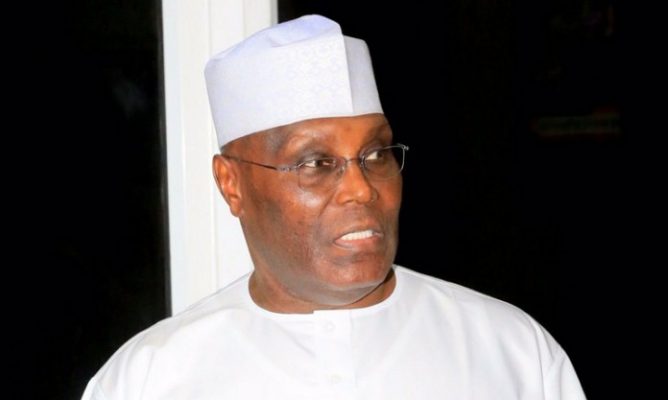

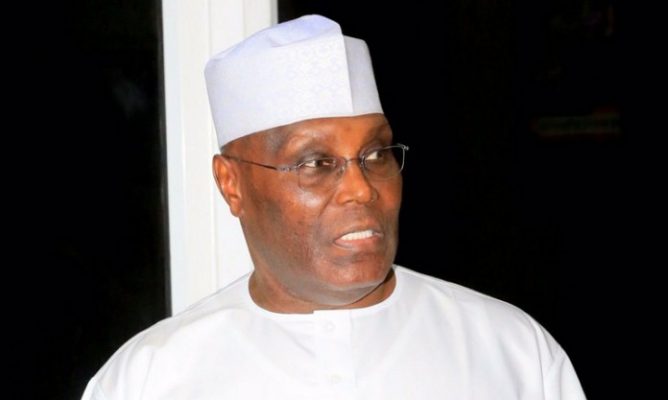
The Presidential candidate of the Peoples Democratic Party, PDP, in February 2019 election, Atiku Abubakar, has accused the government of president Muhammadu Buhari of persecuting a former President of the Senate, Dr. Bukola Saraki.
Atiku said this in a statement on Tuesday titled, ‘Bukola Saraki: Silence in the face of tyranny as acquiescence,’ noting that Saraki is one of the most investigated politicians in Nigeria.
According to him, fresh investigation of Saraki by the Economic and Financial Crimes Commission, EFCC, over his tenures as Kwara State Governor, between 2003 and 2011 and Senate President from 2015 to 2019, could objectively could be seen as persecution instead of prosecution.
The former vice president pointed out that Mr. Saraki had been investigated and prosecuted all the way to the Supreme Court by Federal Government, and he was cleared of the charges.
That should have been the end of the matter, Atiku said.
“Saraki, the immediate past Senate President, is one of the most investigated politicians in Nigeria. He has been investigated and prosecuted all the way to the Supreme Court and has prevailed against his accusers. It was expected that that should have been the end of the matter.
“However, the revival of previously investigated cases and the fact that Saraki was politically opposed to the administration of Muhammadu Buhari seems to give strong grounds for objective bystanders to conclude that his current travails have gone beyond prosecution and are now tending towards persecution.”
Atiku made it clear that he was all for prosecuting corrupt people, but said it was wrong to use the instruments of state to persecute political opponents.
He urged the former Kwara governor to stand firm and take solace in the fact that Nigerians still hold the constitution higher than any other authority.
Atiku stated that he would always stand up for the constitution and Nigeria, asking Nigerians, especially those tasked with upholding the constitution and the laws of the land, to note that silence in the face of oppression is akin to acquiescence.
 cpcnews.org