
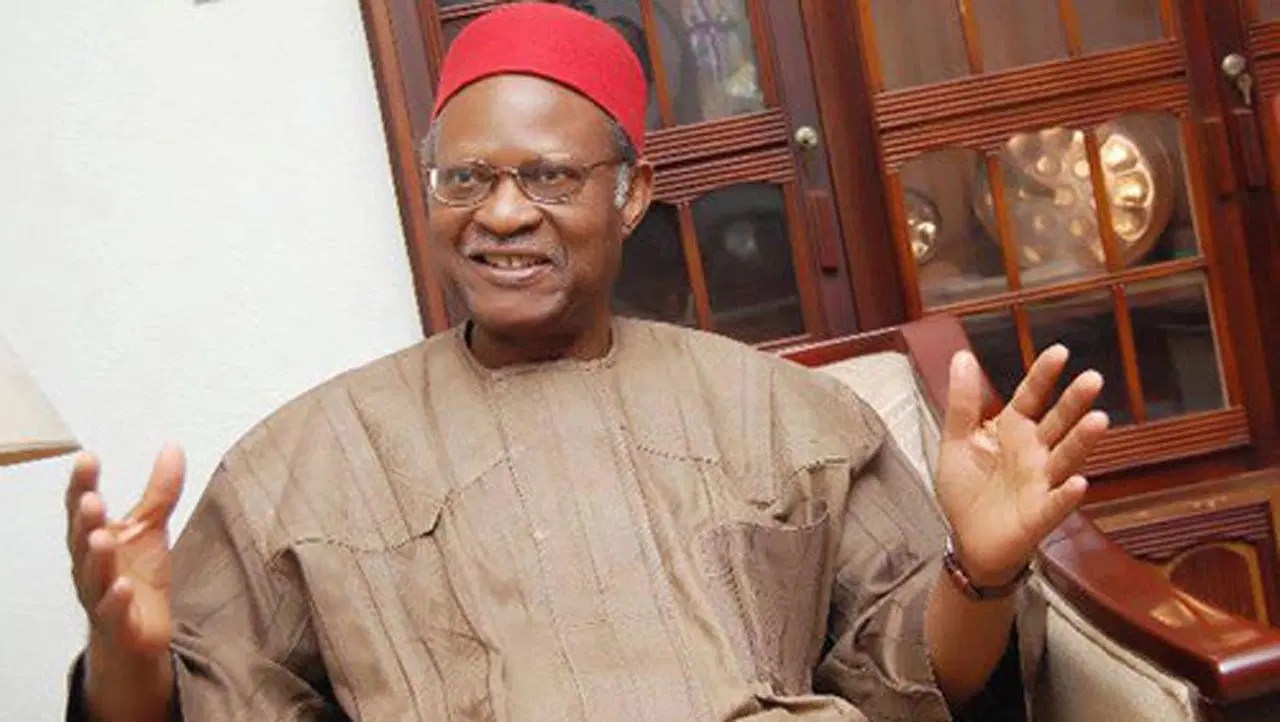


Former Commonwealth Secretary-General Chief Emeka Anyaoku Wednesday warned that Nigeria will make no progress until the 1999 ‘unitary’ Constitution is discarded.
The elder statesman said this at the launch of the book: ‘The Noble Academic and Patriot: A Biography of Emeritus Professor Akinjide Osuntokun,’ held at the Nigerian Institute of International Affairs, NIIA, in Lagos.
He faulted the 99 Constitution bequeathed on the nation by a military junta as unitary, saying united and progressive pluralistic countries were those who addressed their diversity with true federal constitutions.
With the 1999 Constitution, not even Angel Gabriel or Mala`ika Jibril could tackle Nigeria’s challenges, Anyaoku said, rejecting the notion that the trouble with Nigeria is not political leadership.
According to him, Nigeria, like many other countries across the world, is a pluralistic country whose population comprised peoples long established in their separate geographical areas with different histories, cultures, languages and religions.
He said, “The universal lesson is that pluralistic countries, which have survived as single political entities in unity and progress, are those that address their pluralism, that is, their diversity, with genuine federal constitutions. Examples of such countries are India, Canada and Switzerland. The other pluralistic countries, which failed to manage their pluralism with true federal constitutions, eventually disintegrated.
“Examples of these include Yugoslavia, which after 74 years of existence broke into seven sovereign states; Czechoslovakia, which separated to two independent states, East Timor, which separated from Indonesia, and coming nearer home here in Africa, Sudan, which broke into two separate countries after almost 3,000 years of existence as a country. I believe, therefore, that if our pluralistic Nigeria is to achieve true unity and political stability, and to successfully tackle the serious challenges that the country faces, it must have a truly federal constitution.
“The divisiveness, the underperforming economy with the resultant massive poverty, the insecurity, the humongous corruption and the other major challenges currently facing Nigeria. My warning, therefore, is that for the sake of preserving our country, the Federal Government and National Assembly should not delay any longer acting to what is clearly a universal lesson. We must have a true Nigerian peoples democratic constitution based on the principles that underlie our 1960/63 Constitution, which was hence technically negotiated and agreed by the founding fathers of independent Nigeria.
“As many of us in this room will remember, Nigeria was more united, more stable, and developing towards achieving its potential after that constitution until the military intervened in governance in January 1966 and introduced a unitary constitution that has virtually existed, albeit in different forms, until today.”
 cpcnews.org