
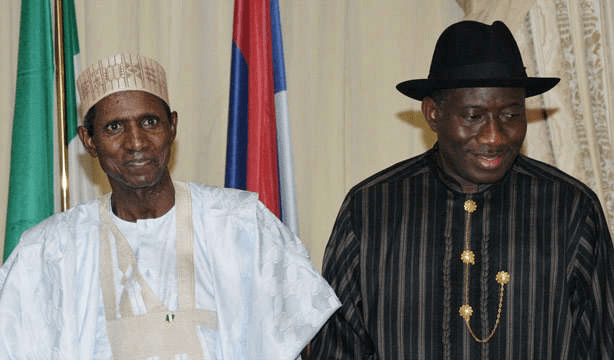

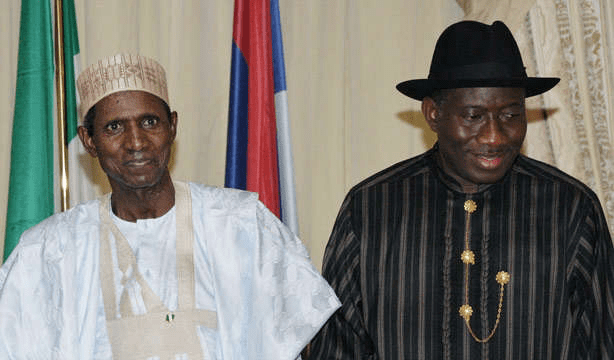
Former President Goodluck Jonathan has revealed that the deliberate refusal of a presidential aide to transmit a crucial handover letter to the National Assembly was what plunged Nigeria into a constitutional crisis during late President Umaru Musa Yar’Adua’s prolonged illness.
Speaking during an interview with Rainbow Book Club, trending on Saturday, Jonathan disclosed that Yar’Adua had written a formal letter to empower him to act as president before travelling abroad for medical treatment in 2010, but the aide entrusted with the document declined to sent it to lawmakers as was ordered by his boss.
Jonathan, who did not name the culprit, said the aide’s action left the country without an acting president or commander-in-chief for months.
According to him, while he could perform executive functions as vice president, including presiding over Federal Executive Council meetings and approving ministerial memos, he lacked the constitutional authority to act as commander-in-chief without the formal letter.
He noted that the crisis forced the National Assembly to invoke the “doctrine of necessity,” empowering him to act as president without an official letter, a move he compared to the swift transition protocols in the US.
Jonathan said: “There’s always a balancing between North and South, Muslims and Christians. And Yar’Adua was a Northern Muslim, serving as president. He took over from a Southern Christian, Obasanjo, who ruled for eight years.
“Definitely the Northern Muslims wanted Yar’Adua to at least do eight years before power would return to the South, likely to another Christian. But his health issues came up and it was a problem. That’s why even allowing me to act as president became an issue.
“One year that Yar’Adua was going for the medical checkup. Actually, a letter was written. Of course, the constitution says that for the vice president to act, the president would send a letter to the Senate and the House of Rep informing them.
“That letter was written, but the person who the letter was handed over to, I will not mention the name to you now, was one of the aides of Yar’Adua, refused to submit the letter to the National Assembly. And Yar’Adua became so ill that he had no control of issues.
“So we had a country where the president was not available, and there was no acting president. Yes, as a vice president, you can take over the responsibilities of, some responsibilities of the president. You know the president of Nigeria has two main responsibilities.
“First, you are the chief executive of the country, so like a prime minister of a country. That, the vice president can assume, you don’t need any transfer. And I was doing that because we were having an executive council meeting, we were approving memos from ministers, so the government was going on.
“But there was no commander-in-chief. What is the second responsibility of the president of Nigeria, besides being the executive head of the country? And there’s nothing like acting commander-in-chief. Either you’re a commander-in-chief or not.
“But when you become an acting president, you are at the same time a commander-in-chief. So that was lacking, and no country allows that gap. A country like America, they don’t allow that gap at all.
“If an American president wants to, even if it’s a whitlow, that he requires an extension, that he will be off for five minutes, he will hand over to the vice president before that procedure. Immediately he regains consciousness, he takes over. But we stayed for some time.
“And that led to what they call the doctrine of necessity. When the National Assembly felt that the country was in a situation where it was not expected, they now have to initiate this doctrine of necessity. And they now made me to act as a president without a letter from Yar’Adua.”
 cpcnews.org