
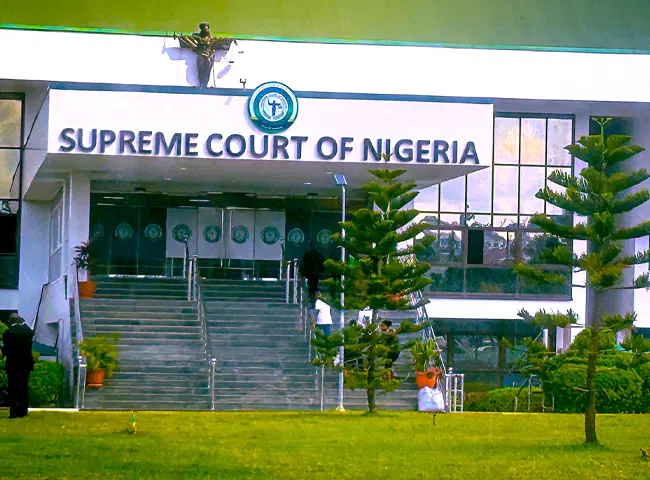

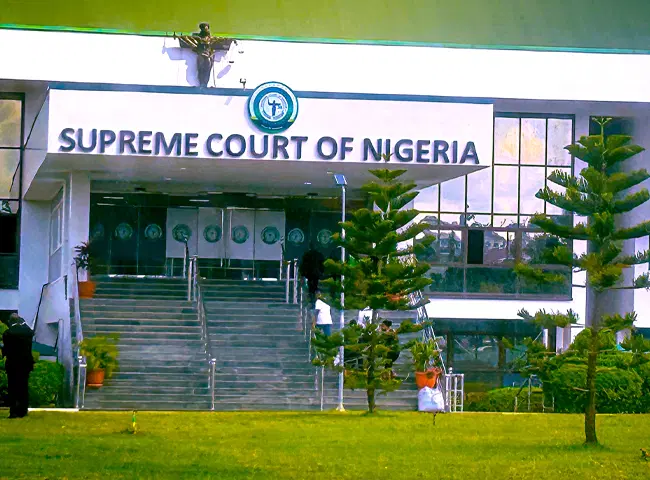
Again, Nigeria’s highest court, the Supreme Court; has failed to defend the country’s constitution and its democracy when it held on Monday that the president has powers to sack elected executive governor of a state and members of a state legislature.
The apex court in dismissing a suit by 11 states of the federation, challenging President Bola Tinubu’s unconstitutional sacking of Rivers State Governor Sim Fubara and members of the State House of Assembly, held that section 305 of the 1999, Constitution, as amended, empowers the president to deploy extra ordinary measures with a view to restoring normalcy where emergency rule was declared.
The judgement, with one Justice dissenting, was read by Justice Mohammed Idris on behalf of a panel of seven.
They held that Section 305 was not specific on the nature of the extraordinary measures, thus, granting the President the discretion on how to proceed with any situation at hand.
However, the court ignored other sections of the constitution, which provides how a sitting governor can be removed, which could only be by impeachment.
The court further affirmed the constitutional powers of the President to declare a state of emergency in any state of the federation to avert the breakdown of law and order.
Today’s decision left many Nigerians, who had looked up to the Supreme Court to annul Tinubu’s executive overreach in suspending Rivers elected officials on March 18, 2025, disappointed.
Recall that the same court had also in the presidential election petition case, ruled that a presidential candidate does not need to win 25% of the votes in the Federal Capital Territory, Abuja, contrary to the express provisions of the constitution.
The current president, Tinubu, failed to meet that constitutional threshold, yet his controversial election victory was upheld by the learned justices.
Monday’s ruling comes at a time when the confidence of Nigerians in the country’s judiciary is at its lowest ebb, and it would further go to erode the position of the court as the last hope for the common man.
The states, which were controlled by the opposition Peoples Democratic Party, PDP, through their respective Attorneys-General, has approached the Supreme Court to scrutinize President Tinubu’s statutory powers to suspend a serving governor, the deputy governor, and members of the State House of Assembly, from office, after the proclamation of emergency rule.
They prayed the apex court to declare that based on provisions of sections 1(2), 5(2), and 305 of the 1999 Constitution, as amended, the president “has no powers whatsoever or vires to suspend a democratically elected governor and deputy governor of a state in the federation of Nigeria under the guise of or pursuant to the proclamation of a state of emergency in the state of the federation by the president, including the states of the federation represented by the plaintiffs.”
The plaintiffs also the court to declare that President Tinubu had no power to suspend a democratically elected House of Assembly of a state pursuant to Sections 192 (4) (6) and 305 of the Constitution of the Federal Republic of Nigeria 1999 (as amended).
They further urged the court to declare that the suspension of Governor Siminalaye Fubara, his deputy and members of the Rivers State Assembly was unconstitutional, unlawful, illegal and utterly in gross violation of provisions of the 1999 Constitution, as amended.
Cited as 1st and 2nd defendants in the suit marked: SC/CV/329/2025, were the Attorney General of the Federation, AGF, and the National Assembly, NASS.
While deciding the case on Monday, the Supreme Court, in its majority judgement that was delivered by Justice Mohammed Idris, held that section 305 of the 1999, Constitution, as amended, imbued the president with the power to deploy extra ordinary measures with a view to restoring normalcy where emergency rule was declared.
Majority of the justices were not persuaded, if the ruling is anything to go by. Rather, the panel upheld preliminary objections the two filed to challenge the competence of the suit.
The apex court claimed that the plaintiffs failed to establish any cause of action that led to the activation of its original jurisdiction.
It said the states failed to show that there was any actionable dispute between them and the federation to require the exercise of original jurisdiction by the Supreme Court.
It stressed that the Supreme Court could only be called upon to adjudicate as a court of first instance, where there is a dispute between the federation and any state or states.
It held that the subject matter of the litigation did not qualify as a dispute between the federal government and any of the plaintiffs on record.
Consequently, the panel dismissed the case on the technicality of want of jurisdiction.
However, a member of the panel, Justice Obande Ogbuinya, gave a dissenting verdict.
Justice Ogbuinya held that upon his careful examination of the case of the plaintiffs, he was satisfied that it succeeded in part.
He held that though the president had the power to declare a state of emergency, however, he could not use such power as a tool to suspend elected officials of the state, including governors, deputy governors and members of the parliament.
Other members of the panel that distanced themselves from the minority judgement, were Justices Inyang Okoro, Chioma Nwosu-Iheme, Haruna Tsammani, Stephen Adah anD Habeeb Abiru.
 cpcnews.org