


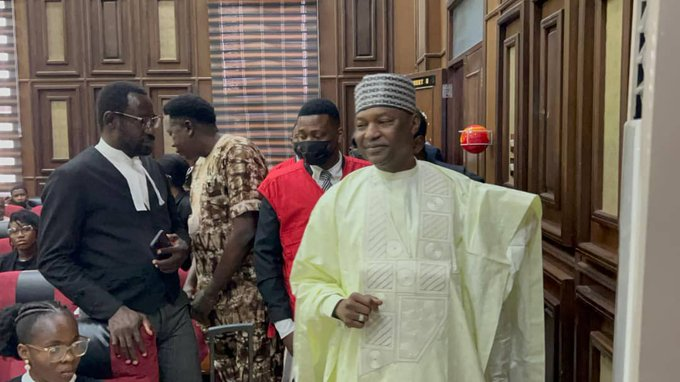
The Federal High Court in Abuja has granted Nigeria’s former Attorney General and Minister of Justice, Abubakar Malami, his wife and son, Abdulaziz bail in the sum of N500 million each with two sureties.
According to Justice Emeka Nwite of the Federal High Court Abuja, the sureties must have landed property in Asokoro, Maitama, Gwarinpa.
The judge also banned the defendants from travelling without the express permission of the court.
The three accused persons had spent the festive season in Kuje prison following their remand after they were arraigned, pending ruling on their bail application.
The Economic and Financial Crimes Commission (EFCC) had filed a 16-count alleged money laundering charge against Malami, his son and his wife, Haija Bashir Asabe.
Malami served as Justice Minister from November 11, 2015, to May 29, 2023, under former President Muhammadu Buhari’s administration.
He was arraigned before the court alongside his son and his wife, who was identified as an employee of Rahamaniyya Properties Limited—a firm allegedly used to conceal proceeds of unlawful activity through property deals.
The defendants were alleged to have laundered public funds totalling about N9 billion.
The anti-graft agency alleged that the former Justice Minister, in a bid to hide his proceeds of crime, resorted to acquiring choice properties in various cities and states, including Abuja, Kebbi, and Kano.
EFCC told the court that the defendants had, between July 2022 and June 2025, used a firm – Metropolitan Auto Tech Limited – to conceal over N1.01bn in a Sterling Bank account.
They were further accused of using the same company to siphon about N600million between September 2020 and February 2021.
EFCC further told the court that the defendants had retained N600m in March 2021 as cash collateral for a N500m loan that the firm — Rayhaan Hotels Ltd — obtained from Sterling Bank, despite allegedly knowing that the funds were proceeds of crime.
The defendants were said to have acted in breach of several provisions of the Money Laundering (Prohibition) Act, 2011.
 cpcnews.org